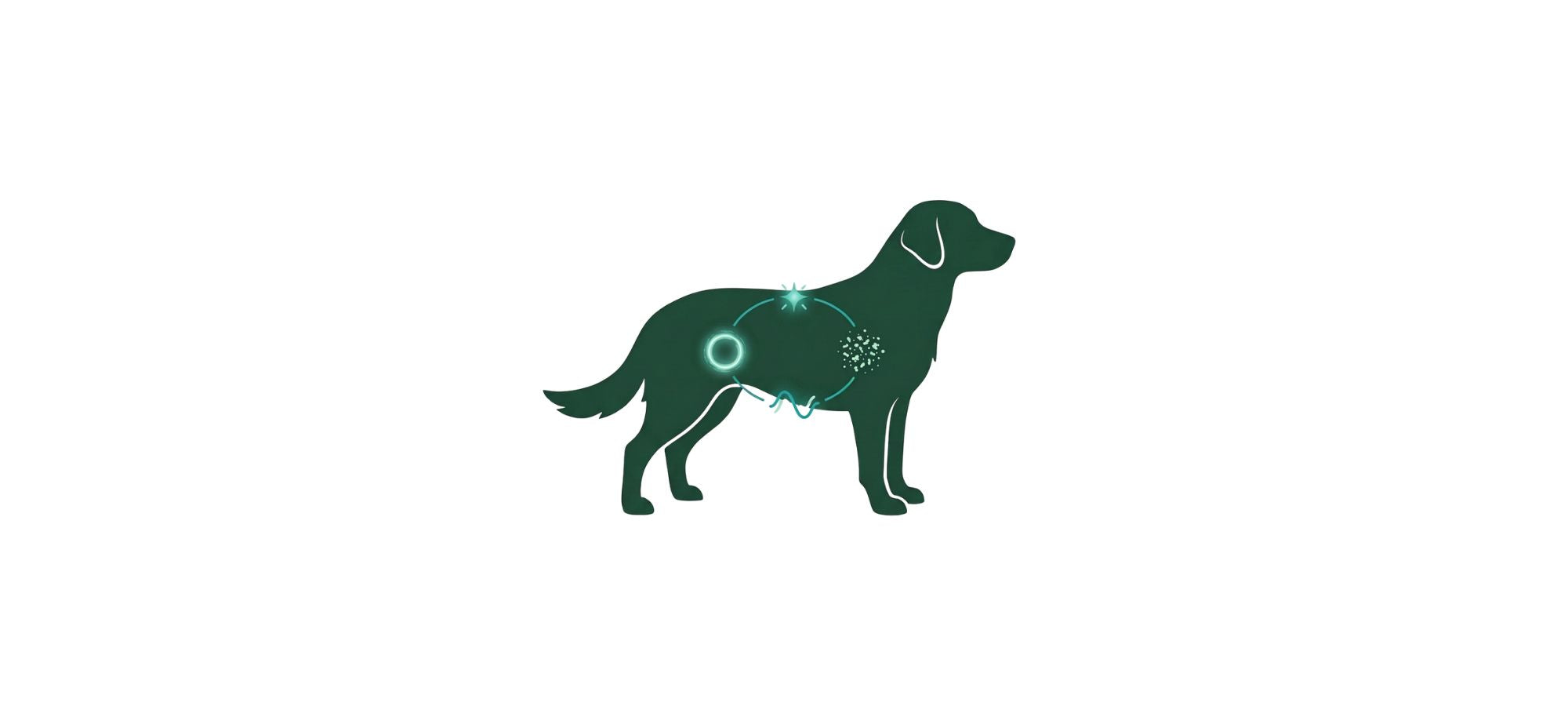
How Your Dog's Body Works in Loops
The Importance of Internal Chemical Signals
You probably think of your dog's health in parts — digestion, energy, joints, skin. We all do. Pet wellness has trained us to think this way, and the supplement aisle reinforces it every time you shop. One product for joints. Another for the belly. A third for skin and coat.
Your dog's body doesn't work in parts. Every system is constantly talking to every other system through chemical signals. The gut sends messages to metabolism. Metabolism sends messages to cells. Cells send messages back to the gut. It's a loop — a continuous conversation happening thousands of times a second.
When that conversation stays clear, dogs thrive. When signals weaken, everything starts falling apart at once, and no single-system supplement can fix what's really going wrong.
Key concept: Biological “loops” are feedback systems—chemical messages traveling between the gut, metabolism, and cells—that help regulate appetite, energy use, recovery, and long-term resilience.

The Gut Runs the Show
Your dog's gut does more than break down food. It's a command center.
Trillions of bacteria live there, working alongside intestinal cells to release hormones that broadcast information to the rest of the body — how much energy just arrived, whether to store it or burn it, when hunger should kick in again.
GLP-1 is one of those hormones. It coordinates appetite, blood sugar, and nutrient absorption across multiple systems simultaneously. When the gut ecosystem is balanced, GLP-1 flows clearly. When stress, age, or poor-quality diet disrupts the gut, those signals get fuzzy.
And when the gut's signals get fuzzy, everything downstream struggles. The gut is where the conversation starts. Disrupt it and the whole network feels it.
Metabolism Translates the Message
The gut sends signals. Metabolism receives them.
The pancreas, liver, and muscles take those chemical messages and turn them into action. Insulin and adiponectin read the instructions and decide what to do — manage blood sugar, store fuel, maintain energy between meals.
When communication is clear, your dog has steady energy, healthy weight, quick recovery after play. When it falters, the body starts misreading its own cues. Energy crashes. Metabolism slows. Weight climbs even though nothing changed in their diet.
This isn't about calories. The body is trying to follow instructions it can barely hear.
Cells Are the Final Stop
Every cell in your dog's body receives these metabolic signals.
Inside each cell are mitochondria — tiny powerhouses that generate energy. They listen to the incoming messages and decide how much power to make and how actively to repair damage.
Strong signals keep those engines humming. Weak signals slow down repair, let inflammation build, and accelerate aging in ways you can see: dull coat, tired eyes, slower recovery after walks. These aren't separate problems. They're one problem showing up in different places.
What Breaks the Loop
Age is the biggest saboteur.
As dogs get older, their bodies produce fewer signaling molecules. The receptors that catch those signals become less sensitive. The body still tries to communicate, but the conversation gets quieter every year — starting silently, often around age seven, years before visible symptoms show up.
A landmark Purina lifespan study¹ tracked dogs for over a decade and found that metabolic health made a measurable difference. Dogs with better metabolic function lived nearly two years longer than their counterparts. That's 657 days, and not from a drug, but from how well the body's signals were working.
Diet matters too. Processed food lacks the nutrients that support signal production. Stress compounds it. Inactivity makes it worse.
The result is what you'd expect: energy swings, digestive issues, dull coat, slow recovery. And most of the supplement aisle is set up to chase these symptoms one at a time — a joint pill here, a probiotic there, an omega oil for skin. That approach has a name. We call it Whack-a-Mole care. You keep swatting at symptoms while the underlying signal failure continues unchecked.
There's a different approach. Support the upstream system — the master signals that keep everything talking — and the downstream symptoms have less reason to appear in the first place.
How to Feed the Loop
Certain plant compounds support GLP-1 activity and metabolic signaling directly. Citrus bioflavonoids show up repeatedly in published research, particularly standardized forms like ERIOMIN® — clinically shown to preserve GLP-1 levels, reduce inflammation markers, and increase antioxidant capacity in peer-reviewed human trials.
Dogs share the same metabolic pathways and receptors. That's not a guess — it's the basis for an active clinical research program translating these findings to companion animals.
Add prebiotics, probiotics, and postbiotics. They feed the gut bacteria that influence hormone production. Together, these nutrients nourish the feedback loops connecting digestion, metabolism, and cellular health.
This is different from anything else on the shelf. You're not masking symptoms. You're maintaining the signals that prevent symptoms from starting.
A Different Kind of Supplement
The gut-metabolism-cellular connection is the clearest example of how your dog's body runs on loops. Researchers are mapping others — inflammation loops, immune response loops, neural communication loops. Each one tells the same story: bodies are built on connection, not isolation.
Support one loop and you strengthen the others. The whole network gets more resilient.
This is the science behind what we call signaling supplements — a fundamentally different category from the symptom-chasing products that fill the pet aisle today. Instead of treating individual problems after they appear, signaling supplements maintain the communication systems that keep problems from forming. The underlying science is called biosignal health, and it's built on decades of research into how master signaling molecules like GLP-1 coordinate whole-body vitality.
What G-Loop™ Does
G-Loop™ is the first signaling supplement for dogs.
Each daily stick pack combines clinically studied citrus bioflavonoids to support GLP-1 activity, a full-spectrum biotic matrix to nourish the gut microbiome, and plant-based antioxidants to protect cells from oxidative stress. Precision-dosed for small, medium, and large breeds. No scoops, no pills, no mess.
G-Loop doesn't chase symptoms. It keeps the conversation flowing — so the signals that coordinate your dog's gut, metabolism, and cellular health stay clear.
Because vitality comes from keeping all the signals working together. (Fixing one thing at a time is old thinking.)
The Bottom Line
Your dog's body is having thousands of conversations every second. Gut to metabolism, metabolism to cells, cells back to gut.
The clearer those messages stay, the better everything works — steady energy, smooth digestion, fast recovery. And when you support those signals before they fade, you're not just treating your dog's health. You're protecting time together.
That's what signaling supplements are built for.
Keep the loop alive.
¹ Source: Purina Life Span Study (Kealy et al., 2002; Lawler et al., 2008) - metabolic decline from age 7 resulted in 1.8 year (657 day) lifespan difference
Frequently Asked Questions
Q: Do dogs actually have the same signaling pathways as humans?
Yes. Dogs share the same GLP-1 pathways, metabolic receptors, and aging hallmarks. That's why human longevity research translates so directly — and why clinical trials are now underway specifically in companion animals.
Q: Is this just another word for a multivitamin?
No. Multivitamins add nutrients your dog might be missing. A signaling supplement supports the communication system that tells the body what to do with those nutrients. It works upstream — at the coordination level, not the ingredient level.
Q: How long before I'd notice anything?
Most pet parents in our beta program reported visible changes in four to six weeks. Digestion tends to improve first, then energy and coat quality follow.
Q: Can I give G-Loop alongside other supplements my dog already takes?
Yes. G-Loop works at the signaling level, so it complements joint, skin, or digestive supplements rather than replacing them. That said, some pet parents find they need fewer individual products once the underlying signals are supported.
Q: Is this related to Ozempic or GLP-1 drugs?
G-Loop is not a drug. It's a natural signaling supplement that supports your dog's own GLP-1 production through clinically studied plant compounds. Pharmaceutical GLP-1 drugs are injectable, prescription-only, and work by a different mechanism. G-Loop nourishes the body's ability to produce and maintain its own GLP-1.